


As we approach the end of the year, we want to take a moment to thank our clients and partners for the trust, support, and collaboration that make our work possible. Your projects continue to challenge us to think creatively and push our designs forward. In that spirit of innovation, we’re excited to share a look at a new pedestrian bridge concept currently under development—one that builds on our long history with fiber-reinforced polymer (FRP) bridges while introducing a structural approach that is both unique and forward-looking.
For many years, our team has been delivering pedestrian bridges built with FRP materials. FRP has proven itself time and again as a durable, lightweight, and low-maintenance solution for pedestrian and light vehicle crossings. While the material itself is not new to us, our latest bridge concept represents a meaningful evolution in how we use it.
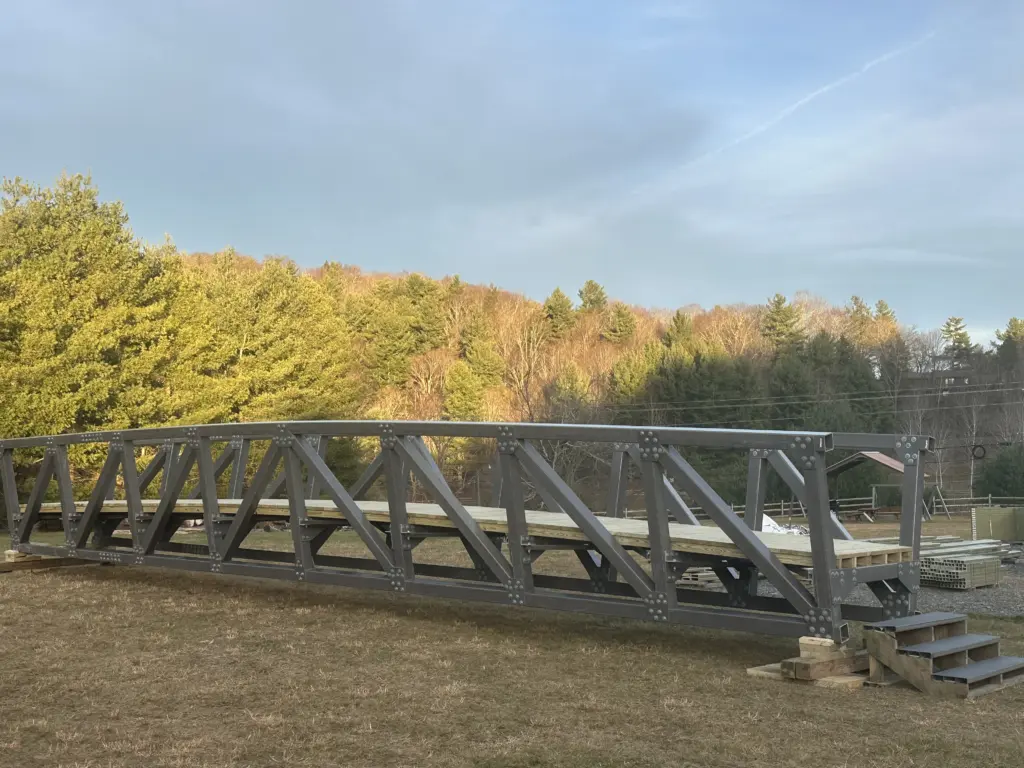
We are currently developing a new pedestrian bridge type that uses square FRP tube members for the primary structural system. Unlike more conventional FRP bridge designs, this concept relies on tubular members for the top and bottom chords as well as the U-frame elements. This approach sets the bridge apart from typical FRP truss systems and from many of the solutions offered by our competitors.
Engineering the Details
Although FRP offers many advantages, designing with tubular members introduces unique challenges—particularly when it comes to connections. A significant portion of this project has focused on engineering robust, repeatable, and constructible connection details.
Our team spent considerable time analyzing load paths, connection behavior, and constructability to ensure the bridge meets performance expectations while remaining practical to fabricate and assemble. The result is a structural concept that takes full advantage of the benefits of square tubes while maintaining the durability and corrosion resistance that FRP bridges are known for.
A Prototype Takes Shape
To validate the design and refine the details, we recently constructed a full prototype of the bridge. The prototype allowed us to evaluate member fit-up, connection geometry, and overall constructability. It also provided a tangible demonstration of the system’s aesthetics and functionality. Photos of the prototype give a clear sense of how the tubular FRP members come together to form a clean, modern truss structure.
Designed with Cyclists—and All Users—in Mind
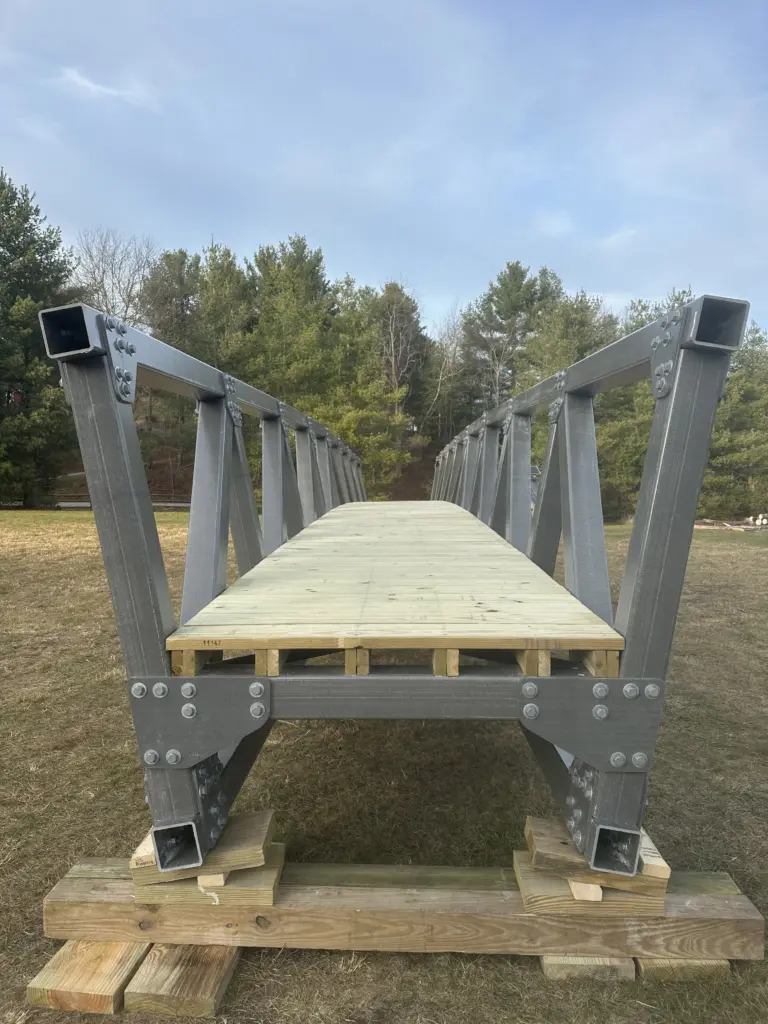
One notable feature of the bridge is its 10-degree flared truss sides. By angling the trusses outward, the bridge provides additional handlebar clearance, making it more comfortable and safer for cyclists to use. Beyond cycling, the flared geometry helps the bridge feel wider and more open overall, improving comfort and usability for all users.
This configuration is also beneficial for equestrians. The increased width at the height of a rider’s legs and saddle bags provides additional clearance, reducing the sense of confinement and improving safety for horse and rider alike. The flared trusses allow the bridge to better accommodate a wide range of users, making it well suited for shared-use paths and multi-modal trail systems.
What’s Next
The next major milestone for this bridge system will be load testing. While that work is still ahead of us, it will provide critical data to further validate the design and confirm performance.
This new FRP tube bridge represents an exciting step forward for our team—building on years of FRP bridge experience while pushing into new structural and geometric territory. We look forward to continuing its development and sharing more as the project progresses.